This Humanoid Teaching Robot Was Built by Secondary School Students in Borno
By Abigail Joseph · · AI & Tech
Secondary school students from six local schools in Borno State built an AI-powered teaching robot aimed at supporting learning in classrooms and communities…
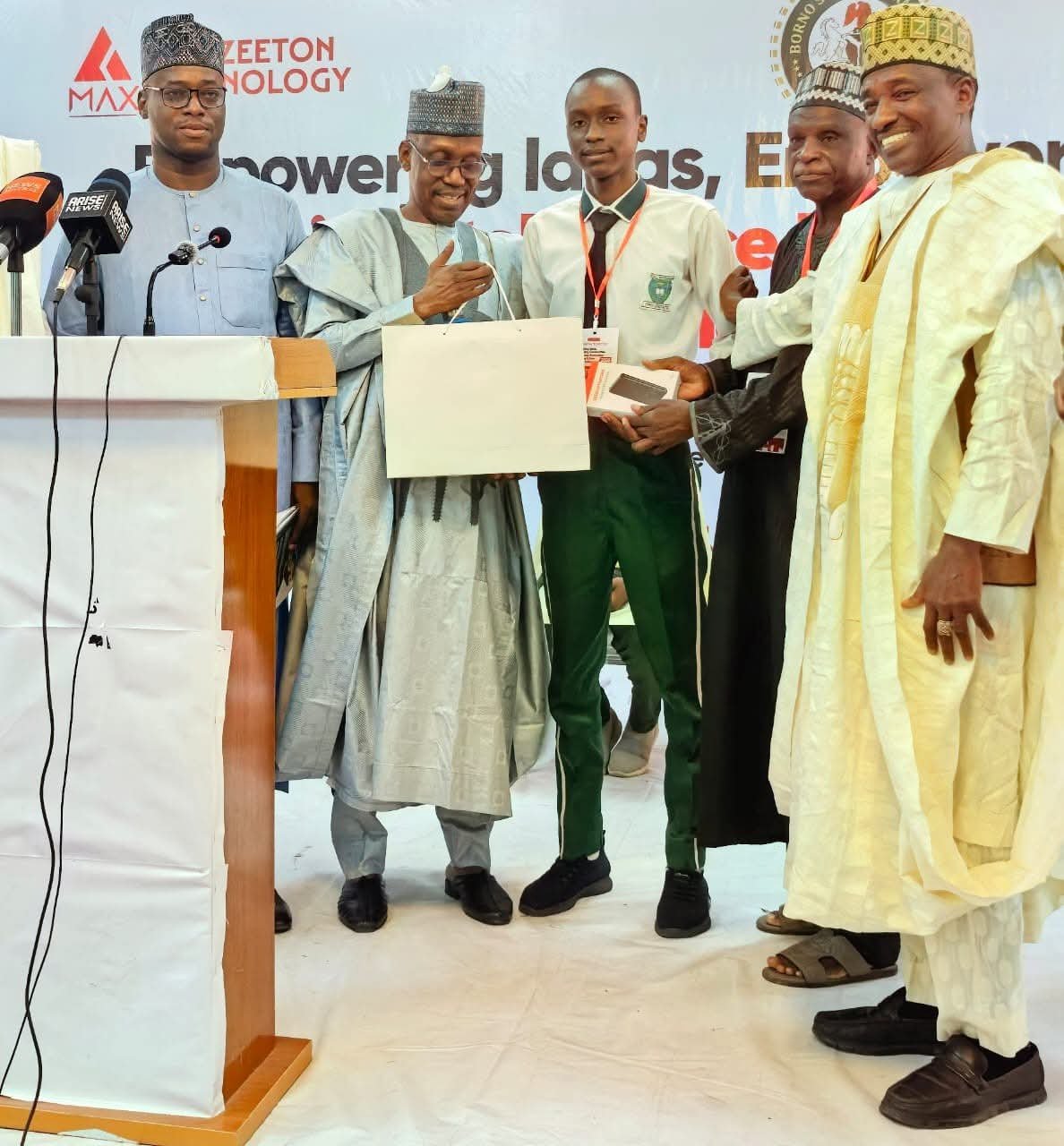
Secondary school students from six local schools in Borno State built an AI-powered teaching robot aimed at supporting learning in classrooms and communities where access to qualified teachers can be limited. The robot, named Max Zulum after Borno State Governor Babagana Umaru Zulum, was unveiled on August 4, 2026, during a graduation ceremony in Maiduguri.The students developed the prototype after taking part in a six-month Artificial Intelligence Bootcamp and Data Analytics Fellowship organised by Maxzeeton Technology in collaboration with the Borno State Information and Communication Technology Development Agency, BICTDA. Their training covered coding, programming, robotics, artificial intelligence and data analytics before they worked together on the robot.

It is still a prototype, however, and no available reporting shows that it has been deployed across Borno schools. At this stage, it has been shown to support questions in primary-level mathematics and science, not across all subjects.

Al-Mustapha Kabir Matazu, one of the student developers, said the training started with basic coding before moving into robotics and artificial intelligence. The robot became the practical project through which the students combined those skills.
What Max Zulum Can Do
Max Zulum stands about 1.2 metres tall and has a display screen built into its chest. A microphone and speaker system allow it to receive spoken questions and respond verbally, giving learners a way to interact with it through speech. It also uses an AI system to process questions and provide explanations.
Source: Nigerian Tribune
Its current focus is primary-level mathematics and science, with the screen used to display step-by-step solutions while the robot explains them aloud. Its developers have also said that it can adjust the pace of its explanations based on how a learner responds.
During the demonstration in Maiduguri, the students asked the robot about how it solves mathematical problems. It responded by taking the problem through its different stages and displaying the steps on its screen. This showed the difference between giving a learner an answer and providing step-by-step explanations they can follow. A machine that can calculate an answer is not unusual. The students are instead trying to build a system that can communicate the process to achieving an answer, using both voice and visual display.
It is still a prototype, however, and no available reporting shows that it has been deployed across Borno schools. At this stage, it has been shown to support questions in primary-level mathematics and science, not across all subjects.
The Students Behind the Project
The training programme began in 2024, according to reporting from Nigerian Tribune and The Sun. It was initially planned to run for six months but was extended to give the students additional time to develop practical projects.
Fatima Abdulrahman, one of the participants and winner of the bootcamp's innovation award, said the experience changed how she viewed the use of technology in her community. She also spoke about developing tools that could help children continue learning when insecurity disrupts access to classrooms. Her comment points to one of the reasons the students' projects is relevant to Borno. They were developing a technology project within an education system that has had to deal with displacement, insecurity and shortages of qualified teachers.
Source: SeedufyTech
The Problem Being Addressed With Max Zulum
The Federal Ministry of Education's Annual School Census data cited in reporting on the project puts Borno's average learner-to-teacher ratio at about 46 students for every teacher. That figure is an average across the state and does not describe every school or classroom.
Their idea was, however, not based on the assumption that a robot can replace a teacher. Max Zulum is intended to provide another form of learning support, particularly for pupils who may have fewer opportunities to interact with qualified teachers. They have also described possible use of this project both at home and in classrooms.
Whether it can do that reliably in actual schools is a separate question.
Taking the Project to the Classrooms
The demonstration does not yet establish how the robot would perform during regular classroom use.
A school environment is much different from a controlled one. The system would have to deal with background noise, multiple students, different ways of speaking and repeated use. It would also need reliable connectivity and hardware that can continue operating over time.
Research on humanoid robots used in schools has identified some of these problems, as researchers recorded issues including inconsistent voice recognition, hardware failures and connectivity problems. The study involved different robots and schools, so its findings cannot be applied directly to Max Zulum. It also does not show whether students learn better with it over a longer period or whether the system can operate effectively in schools with limited technical infrastructure.
For the students who built Max Zulum, the immediate result is a physical project that brings together skills they had spent months learning. They have shown that they can build a system that can interact with learners. The more difficult question, however, is whether it can work consistently enough and provide enough educational value to become useful outside a controlled demonstration.